dimecres, 4 d’octubre del 2017
dimarts, 3 d’octubre del 2017
REALITY-RAJOY, 1-O
Hi, @EU_Commission! Do you really trust @marianorajoy? We invite you to watch this video: pic.twitter.com/g3NrQyjsQj— Crida Democràcia (@CridaDemocracia) October 2, 2017
Escrit per
Jaume
a les
8:00
dilluns, 2 d’octubre del 2017
VIVA LA LEY
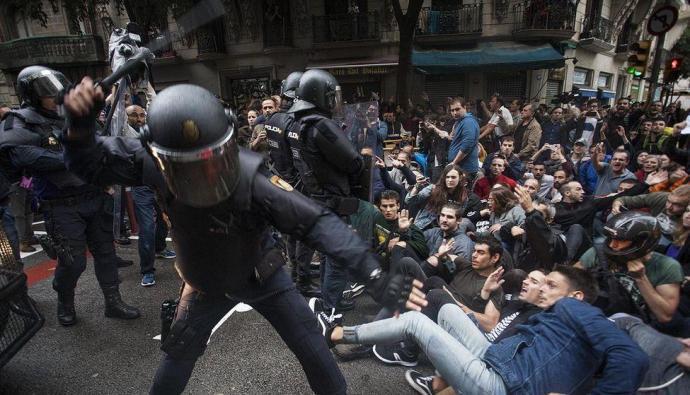
Segons Mariano Rajoy Espanya és "un ejemplo para el mundo", ahir a Catalunya no hi va haver cap referèndum i els únics responsables del que va passar en el no referèndum que no es va fer i que no va produir ni 893 ferits ni centenars d'urnes requisades ni desperfectes a desenes d'escoles ni cap hackeig informàtic per part de la Guardia Civil, els únics responsables deia són els "violadors de la legalitat". Dos o tres milions de catalans som, doncs, d'entrada violadors i, a més, tristos fantasmes que ens pensem que fem coses però no: el que fem no és real, perquè no té lloc. Ho diu el xèrif, Ell que és la llei.

Escrit per
Jaume
a les
8:00
dissabte, 30 de setembre del 2017
dijous, 28 de setembre del 2017
LA HUMILIACIÓ I EL CAMÍ
"No és policia, el que cal per entendre's. Humiliar no és el camí".
Que ho entengui un músic de carrer i ho vegi tan clar, que ho entenguem el vuitanta per cent dels catalans i ho veiem igual de clar i que ni un sol polític ni simpatitzant del Partido Popular, del PSOE ni de Ciudadanos a tot Espanya no sigui capaç de formular-ho així s'explica només perquè malauradament vivim en un país que de fa segles ha fet de la força, l'abús, la trampa i la injustícia selectiva els fonaments de la seva suposada idiosincracia.
Gràcies, Manolo! Algun dia els últims serem els primers.

Escrit per
Jaume
a les
8:00
dimecres, 27 de setembre del 2017
VERDAGUER A SPOTIFY
“Amb son germà, lo comte de Cerdanya, / com àliga que a l’àliga acompanya, / davalla Tallaferro de Canigó un matí”... Si heu escoltat Vittorio Gassman dir la Divina Comèdia o Richard Burton recitant Dylan Thomas i heu pensat com jo que poques coses llibresques s’hi poden comparar, ara en teniu una de nostrada per posar al mateix nivell: Oir, la síntesi del Canigó de Jacint Verdaguer feta per l’actor Lluís Soler. Feta i dita. Soler va presentar la seva versió abreujada del gran poema èpic de mossèn Cinto (amb el permís de L’Atlàntida) el 2011 a Folgueroles, i després la va dur al TNC. Ara la gent de Verdaguer Edicions l’ha convençut perquè es fiqui en un estudi d’enregistrament i, sota la direcció de Roger Mas (de qui són les millors cançons amb poemes de Verdaguer que conec), deixi constància de la seva capacitat per dir tan bé com els millors uns versos densos i intensos, no pas senzills, que ja van camí del segle i mig de vida. El poema de la nació catalana restaurada, segons fórmula de Ricard Torrents.
Passaran els temps i els pressupostos, els grops i els governs, els ministres analfabets i els coronels venjatius, i Verdaguer seguirà dempeus. Passaran els llibres d’autoajuda, les traduccions apressades, els versets floralescos i els reculls de tuits, i Gentil i Flordeneu seguiran volant per damunt del Pirineu, com els campanars de Cuixà i Sant Martí ens admiren encara que la gent ja no sàpiga gaire què es un monestir. Ara tornen tots plegats a les llibreries, i potser tornaran també als escenaris, i en l’endemig s’han escolat, oh meravella, al meu Spotify, entre Bill Evans, Natalie Merchant i els Pulp, al costat de Burton i Gassman, de Bene i Branagh i Nunn i Rickman. Per poc més del que costa la samarreta de la manifestació de cada any (i per una desena part del que costa l’equipació també anual del club que és més que un club), aquí teniu Catalunya per posar-vos-la a l’orella, la de veritat, la que no passa sinó que deixa que ens hi reflectim nosaltres mentre passem. Tot plegat, gràcies a Verdaguer i a Lluís Soler. Oïu-los.
-------------------------------
Publicat a El Periódico, 27-IX-17
Versión en castellano
Escrit per
Jaume
a les
10:12
Etiquetes: Catalunya, LitCat, Llibre i lectura, Teatre, Verdaguer
dimarts, 26 de setembre del 2017
dilluns, 25 de setembre del 2017
diumenge, 24 de setembre del 2017
SOBREDOSI D'ORGULL I AUTORITARISME
Contra aquesta tendència a acumular als mitjans, com a opinadors, gent que no era als llocs opinant sobre coses que desconeix (però en les quals sovint hi té clars interessos), em sembla que necessitem amb urgència veus i punts de vista externs amb coneixement de causa. Per això he demanat a Tom Harrington, professor d'Estudis Hispànics a Trinity College (Hartford, CT), autor de Public Intellectuals and Nation Building in the Iberian Peninsula, 1900–1925: The Alchemy of Identity (Bucknell University Press, 2014), que em deixi incloure al F l u x aquest seu article publicat a Antiwar.com sobre els fets de dimecres de la setmana passada a Catalunya, vistos amb els ulls de nord-americà iberista i, a més, un dels catalanòfils de referència. Aprofito per agrair al professor Harrington el permís per a la reproducció de l'article.
Spanish Centralism or the Self-Defeating Hubris of the Authoritarian Mind
On Wednesday, the Spanish government conducted a number of armed raids upon government ministries in Barcelona, and effectively suspended the charter of the autonomous government to which they belong in order to interdict the circulation of that most dangerous of social threats: ballot boxes and the little paper slips that citizens place in them on polling day.
Catalonia is, like all societies I know of, a diverse and ideologically divided one. There are many people there that identify overwhelmingly with a Catalan past, the Catalan language and, perhaps most importantly, uniquely Catalan patterns of social organization and civic comportment, ones that place an inordinate—at least in relation to traditional Spanish ones—emphasis on negotiation (as opposed to fiats), commerce as (opposed to strategic intimidation and war-making) rational inquiry and the primacy of personal conscience (opposed to obedience to broadly propagated social and religious orthodoxies).
There are other members of Catalan society, and this fact should not be hidden, who identify primarily as Spaniards, and see in the Spanish past the irreplaceable basis of their own personal and social identity, and who often invoke Spain’s (which is to say Spain’ Catholic and imperialist Castilian heartland) as the root of all that has made Spain great and a player on the world stage for more than 500 years.
Between them are a number of people who feel both deeply Catalan and deeply Spanish and see no reason why they should have to choose between the two.
There is, of course, a well-known mechanism for resolving divided opinions about the future direction of a societies, and for that matter, the future directions of boards of directors and neighborhood associations, just to mention a few.
It’s called taking a vote. And it is this simple democratic mechanism—nothing more and nothing less—that a clear majority of Catalans want to avail themselves of on Sunday October 1st.
There is only one problem. The Spanish central government, led by Mariano Rajoy and his cabinet of ministers drawn largely from what is often called the “sociology of Francoism” is dead set against their doing so.
That people in Scotland addressed the matter of their possible independence this way with the full acceptance of the UK government in 2014 does not move Rajoy and his dour band of señoritos.
Nor does the fact that Canada allowed the people of Quebec to do this very same thing in 1995, or that numerous of the states of the former Communist and non-aligned blocs of Europe, states that now belong to the EU and are recognized by Spain, came into being in through very similar processes.
For most of the years since the ratification of the Spanish post-Franco Constitution in 1978 the matter of independence was a non-starter for a broad swath of the Catalan political establishment.
What changed things?
What changed things was the election of José María Aznar, the son of an important propagandist for the Francoist regime, as prime minister in 1996 with a clear—albeit at first skillfully camouflaged—program to roll back the regime of timid decentralization that grew out of the aforementioned post-Franco Constitution.
His first steps, taken in the last years of the last century, came in the realm of education and culture where he used government power and a web of think tanks and media outlets sympathetic to it, to rehabilitate the idea, near and dear to his base with its roots in the authoritarian right, of Castile and the Spanish language as the only true motors of Peninsular history.
Integral to these efforts was the drive to ridicule any notion that the other “culture nations” of the state (Catalonia, Galicia and the Basque Country) might have any reason to think of themselves as integrally constituted social and political entities.
Upon his re-election in 2000, he and his government took the effort to freeze and eventually roll back autonomous rights up another notch by launching a campaign for what they called Constitutional Patriotism. The promoters of this idea held that the Constitution of 1978, a compromise document forged under the duress of Francoism’s still very heavy shadow (and its always present threat of a coup d’etat, something that in fact was attempted in February of 1981) which most of his party and its direct political forebears had in fact opposed, was now to be frozen in in time as the perfect embodiment of Spanish democracy, and just as importantly, as the sole template for managing the co-existence between the country’s differing national and linguistic communities.
That they had cribbed the idea of Constitutional Patriotism from the esteemed German thinker Jürgen Habermas, a man who stands for almost everything they do not in terms of the importance of sincere democratic participation and deliberation, demonstrates the breathtaking cynicism of those pushing this idea.
In 2004, the Socialist and sitting president of Catalonia, Pasqual Maragall—aware that the voters of his Catalan autonomous community had been a key element (along, that is, with the Aznar Government’s blatant lying about the origins of the Madrid train-bombing attacks ) to José Luis Zapatero’s surprising accession to the premiership of Spain in March of 2004—decided it was a good time to renegotiate the agreement on Catalan autonomy that had been forged in the so-called Spanish transition to Democracy.
The changes sought were relatively minor, revolving around a desire increase local control of public revenues and the right to refer to Catalonia as a cultural nation within in the context of an overarching Spanish democratic state.
Following the dictates of the Constitution of 1978, Maragall forged a new Statute of Autonomy in the Catalan Parliament during 2004-05. Then, and again in keeping with the procedures of the 1978 Constitution for such things, it was sent to Madrid for approval by the Spanish Parliament where, after a good deal of scaling back, it was passed by a majority in May of 2006.
It was then brought back to Catalonia and approved by popular referendum, with a 74% level of approval.
Aware that the new statute would deal an important blow to their plan to reinstitute unquestioned Castilian supremacism within Spain, Aznar’s Party turned to the country’s Constitutional Tribunal, confident that the deeply conservative jurists they had planted there during Aznar’s eight years in power would gut the new law in a way the elected representatives of the Spanish people had refused to do.
During the prolonged judicial deliberations on the new Statute of Autonomy (2006-10), the PP’s spokespeople did not even try to hide their glee at having been able to pack the court with people who they knew would “do the right thing” for them on the new statute.
When, in the summer of 2010, the Constitutional Tribunal did indeed nullify important parts of them 2006 law, including the right of Catalans to legally refer to their collective as a nation, Catalans took to the streets massively in protest.
They believed that the Spanish state could no longer be considered a good faith negotiator. They had played by the rules of the state and its constitution and won new rights, albeit much less than they originally wanted.
However, using its effective control of a deeply and transparently corrupt judiciary, the PP had managed to overturn this impeccably executed constitutional reform.
Since this time, the entire tenor of Catalan politics has changed. Independentism, which until 2010 was still a decidedly minority option in Catalonia, has grown immensely.
In the September 2015 elections a coalition of independentist parties called Together for Yes (Junts pel sí) won a slim majority of seat in the Catalan Parliament. Realizing the thinness of the mandate, they decided that the issue of independence would be best resolved by a popular referendum.
In November of 2014, a similar attempt to hold a referendum had been made. The Spanish government said it would not consider it legitimate and that the government leaders who promoted it would be threatened by legal action.
Despite making sure that the government was not the direct sponsor of the vote (which relied on the efforts of private funds and civic volunteers for its operations) the then Catalan president Artur Mas and two other members of the Catalan government were indicted by the Spanish courts.
The vote went on as a non-binding referendum that was won handily by the independentist option. In March of 2017, Mas and his two cohorts, Joana Ortega and Irene Rigau, were nonetheless sentenced by Madrid to two-year bans on their right to serve as elected officials.
Believing that the pro-referendum majority in the Catalan parliament achieved in September of 2015 might help the political establishment in Madrid reconsider their opposition to the a vote on independence the leaders of Together for Yes (Junts pel sí) have repeatedly stated their desire to have a negotiated referendum. Indeed even today, they continue to say quite clearly that this is their first preference.
The Rajoy government, backed on this particular issue by the so-called “left” Socialist party—PSOE—has said just as repeatedly, and often with great disdain, that there is absolutely nothing to talk about.
And it thus that we have arrived at the reality that we are living today, with the confiscation of ballots and ballots boxes, and the arrest of officials whose only crimes is wanting to allow their constituents to vote on their own future as a people.
All this, with helicopters flying overhead and troop ships arriving to Barcelona’s harbor to house the “loyalist” police brought from other parts of the state to put down a completely peaceful citizen uprising.
Over the last four decades, right wing parties all across the so-called west have, through their mastery electronic media messaging, become quite skilled at hiding their deeply felt and deeply lived authoritarian ideals from the general public.
But as the Greek dramatists showed us more than 2000 years ago, success in high places over time will inevitably lead to hubris.
Here in the US, Trump has heedlessly stripped the last fragments of our brutal establishment’s carefully-constructed mask of civic gentility.
Mariano Rajoy and his pathetic government, along with the now fully corrupted “Socialist” backers (think of a party full Clintons, Pelosis and Schumers) are now doing the same in Catalonia.
The pace of such anagnoretic events (anagnoresis: the point in the plot especially in a Greek tragedy tragedy at which the protagonist recognizes his, her or some other character's true identity or discovers the true nature of his or her own situation) is sure to spread and accelerate in the coming months.
As it does, we should thank our friends in Catalonia for their refusal to back down in the face of intimidation, and for believing in the force of peaceful endurance, and its ability force the authoritarians show us who they really are, and have, in fact, always have been.
Escrit per
Jaume
a les
9:30
Etiquetes: Barcelona, Catalunya, Espanya, EUA, Política, Universitat
dissabte, 23 de setembre del 2017
VOTARÉ PER TU
El vídeo d'aquesta setmana no és musical. Però s'enganxa com una cançó de primera. Ah, i no us en perdeu els subtítols (ni, els bons lectors, el palimpsest).
Bon cap de setmana a tothom, i bona Mercè als barcelonins.
Escrit per
Jaume
a les
10:00
divendres, 22 de setembre del 2017
QUÈ ES VEU EN L'ESTRETOR
—Deje de escribir tanto y duerma una hora más —decía repetidamente cuando se daba cuenta de que me había levantado demasiado temprano—. Con todo esto que escribe sólo pone su vida en peligro. ¿Cree usted que está viviendo algo tan extraordinario? ¿No sabe usted que miles de otros viven situaciones mil veces peores? ¿Y no cree usted que se encontrarán cantidades ingentes de historiadores para describir todo esto? ¡Gente poseedora de mejor material y de una mejor visión que usted! ¿Qué vé, qué observa en esta estrechez? Todo el mundo tiene que ir a la fábrica, muchos reciben palos, y el hecho de ser objeto de los escupitajos ya no escandaliza a nadie...
La cosa muchas veces seguía así un buen rato mientras permanecíamos en la cocina en nuestras horas libres, ayudando a nuestras mujeres a lavar la vajilla y a limpiar las verduras.
Victor Klemperer, LTI. La lengua del Tercer Reich (Minúscula, 2001)

Escrit per
Jaume
a les
11:02
Etiquetes: Alemanya, Catalunya, D'escriure, Espanya, Política